


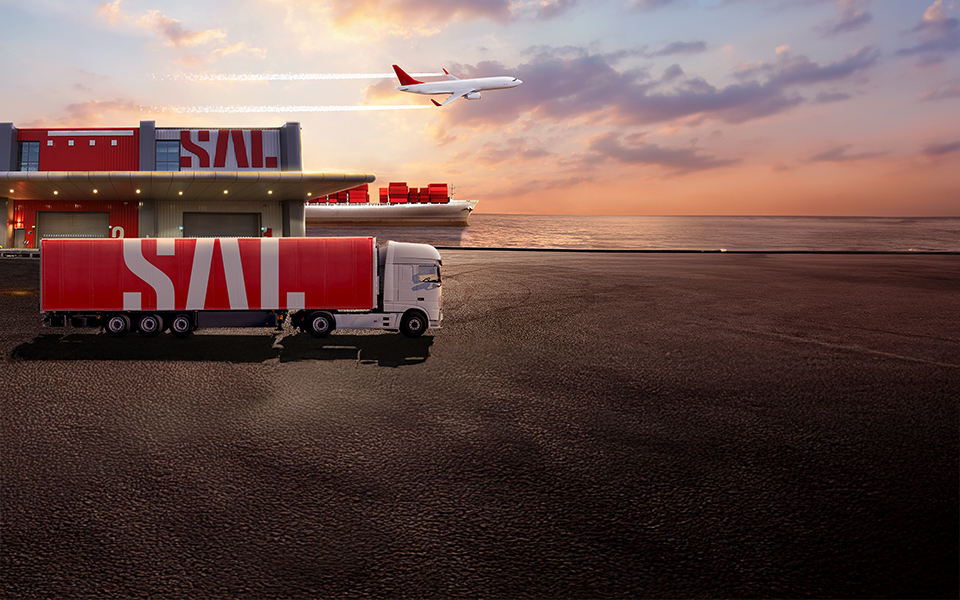



The Logistics Division
A Growth Platform Taking Shape Across Sea, Air and Land
Launched in October 2021, SAL Logistics represents the Company’s strategic expansion beyond airport-based cargo ground handling into a fully integrated, end-to-end logistics platform.
What began as a capability extension has rapidly evolved into a scalable growth engine. Today, the division accounts for 15% of SAL’s 2025 total revenue and plays a critical role in extending the Company’s value chain beyond the cargo handling, connecting global freight flows with domestic distribution and specialized logistics solutions.
SAL Logistics provides a broad range of services including freight forwarding and contract logistics, with a strong focus on specialized solutions such as events and project logistics, cold chain and hazardous materials handling, as well as niche services including fine art logistics and record management. The division serves niche yet high-demand and structurally growing sectors including e-commerce, pharmaceuticals, perishables, mega-projects, sports events, fine arts, and government-related logistics. Through an integrated model that combines freight management, contract logistics, and specialized services, the division acts as a strategic partner to businesses operating across the Kingdom and internationally.
Supported by a nationwide warehousing footprint and a global partner network, SAL Logistics delivers coordinated inbound and outbound logistics solutions, domestic distribution, and post-shipment services, providing customers with enhanced visibility, operational control, and execution reliability.
The Logistics Division has been developed as a diversified portfolio of services, reflecting a platform that is progressively being built and deployed. The portfolio spans services that are already operational, services that are being deployed, and services addressing more specialized logistics needs, allowing SAL to expand capability while maintaining operational control.
At its core, the Logistics Division currently delivers four established services: freight forwarding across sea, air and land; project logistics for oversized, high-value or complex cargo; events and sport logistics, covering the movement, storage and on-site handling of equipment; and fine arts logistics for the secure transport, storage and handling of high-value artworks.
Building on this foundation, SAL has begun deploying its contract logistics offering, including an end-to-end management of warehousing and transportation solutions. These activities are supported by a network of leased warehouse facilities in Riyadh and Dammam, providing the operational base required for storage, fulfillment, and distribution activities.
In addition, the Division’s portfolio includes services at earlier stages of deployment and planning, designed to address specialized requirements. These include hazardous materials logistics, cold chain logistics for temperature-sensitive cargo, and records management services for the secure storage, digitization, and retrieval of physical and digital records.

Forwarding

Logistics

Logistics

Logistics

Logistics

Materials

Chain

Management
This structured rollout reflects SAL’s disciplined approach, prioritizing operational control, quality of execution, and commercial sustainability before scaling-up.

Logistics
Key Financial and Operational Metrics (FY 2025)
X 252 million
(-7% YoY)
Revenue
15%
(-1.9pp compared to 2024)
Revenue contribution from SAL Overall Revenue
-5.2%
EBIT Margin
3 facilities
Number of warehouses
45.9k sqm
Logistics warehouse area
+25
New contracts secured
+20
Number of key customers retained
3
Number of new products/services launched
+12,600 Tonnes
Air Freight Weight
+2,000 TEUs
Sea Freight (TEUs)
+800 trip
Road Freight Trips
100%
On-time Delivery Performance
While revenue moderated year-on-year, this reflects a deliberate focus on building operational infrastructure, expanding service capabilities, and strengthening the commercial pipeline. The negative EBIT margin was primarily driven by investment-related costs and one-off items during the scaling phase.
- Key Partnerships and Agreements
During the year, SAL Logistics strengthened its commercial footprint through several notable partnerships, including:
| Partner | Service |
| King Salman Humanitarian Aid and Relief Center | Integrated Logistics Services |
| Emaar the Economic City | Strategic collaboration in Logistics Sector |
| Flyadeal | Comprehensive logistics service support |
| Riyadh Air | Dedicated operational facility at King Khalid International Airport, along with a comprehensive suite of logistics services |
| Special Integrated Logistics Zone Company (SILZ) | Logistics solutions for SILZ’s zone tenants |
| AFC CUP 2027 Local Organizing Committee Company | Event logistics and supply chain services |
SAL Logistics Revenue Summary
(FY 2025 Vs 2024)
|
Year |
Q1 |
Q2 |
Q3 |
Q4 |
|
| Revenue | 2025 | 62 | 55 | 49 | 86 |
| 2024 | 87 | 72 | 38 | 74 | |
| Change % | -29% | -24% | 29% | 16% | |
|
Share of SAL Revenue |
2025 | 16% | 14% | 12% | 17% |
| 2024 | 19% | 18% | 10% | 18% | |
| Percentage Point | -3.0pp | -3.8pp | +1.2pp | -1.3pp |
- Maintaining Operational Excellence and Competitive Positioning
The Saudi logistics market remains fragmented, creating clear opportunities for scaled, integrated operators. SAL Logistics differentiates itself by operating as a platform, not a point solution. Through integrated freight, contract logistics, and specialized services, the division provides customers with a coordinated, end-to-end value proposition across sea, air, and land.
This integrated model is reinforced by tailored, specific execution capabilities. Whether supporting aviation partners, mega projects, government entities, or event organizers, SAL delivers customized logistics solutions complemented by value-added services such as customs clearance support, documentation clearance procedures, on-site services, picking and packing, consolidation, cargo insurance support, etc. This capability depth allows the division to move beyond transactional freight activity into long-term strategic relationships.
Geographic concentration across Riyadh, Jeddah, and Dammam strengthens the network effect, enabling efficient domestic distribution while maintaining seamless integration with global freight flows. Underpinning the platform is increasing digital enablement, enhancing shipment visibility, operational control, and customer transparency across the logistics chain.
- Operating in a Structural Growth Environment
Logistics is a cornerstone of Saudi Arabia’s Vision 2030 transformation agenda and one of the Kingdom’s designated priority sectors. Demand for logistics solutions is projected to grow at approximately 11% annually through 2030, representing a market opportunity approaching X 70 billion by the end of the decade. Sector contribution to GDP is expected to increase materially, supported by regulatory reform, infrastructure expansion, and deeper integration into global trade corridors.
The planned expansion from 22 to as many as 59 logistics zones, including 18 near major ports, alongside rising shipment volumes and ambitions to reach a top-tier ranking in the World Bank’s Logistics Performance Index, signals structural and sustained momentum.
SAL Logistics is strategically aligned with this transformation. The division’s infrastructure build-out, service diversification, and integration with SAL’s cargo ground handling platform position it to capture growth as the market scales. The strategy is proactive rather than reactive investing ahead of demand to secure long-term relevance and competitive advantage.
- Financial Performance: Expanding Capabilities, Driving Performance
2025 marked a disciplined investment phase for SAL Logistics. Revenue reached X 252 million, reflecting a measured year-on-year decline as management prioritized infrastructure expansion, service deployment, and operational platform strengthening. The reported negative EBIT margin was primarily driven by scaling costs and one-off impacts associated with this build phase.
Importantly, operational fundamentals remained strong. The division secured more than 25 new contracts, retained key strategic customers, expanded freight volumes across air, sea, and road, and maintained 100% on-time delivery performance. These indicators reinforce execution discipline and customer trust, essential components as the division transitions from foundation-building to scalable growth.
SAL’s focus remains on converting infrastructure investments and commercial pipeline momentum into margin expansion over the medium term, supported by operating leverage as capacity utilization increases.
- Key Growth Drivers for SAL’s Logistics
We see these ambitions being met through contributions from three main avenues:


Key Growth Drivers for SAL’s Logistics
Broadened Service Offering
Growth fueled by warehouse management contracts, event logistics, and launch of the Dammam and Riyadh warehouse centers
Expanded Infrastructure & Network Reach
New facilities, RFS expansion, and enhanced capabilities across key airports and logistics corridors
Inorganic Growth
Potential joint ventures, strategic partnerships, and targeted acquisitions to accelerate scale and geographic reach
- Anchoring Capacity Expansion Across the Kingdom
SAL’s logistics expansion strategy is anchored around Riyadh, Jeddah, and Dammam, the Kingdom’s primary commercial and trade hubs. The current footprint provides a solid operational base; however, the most significant capacity acceleration lies ahead. In Riyadh, the SAL Malham Zone development is expected to materially expand warehouse capacity, supported by an additional expansion pipeline. In Jeddah, the operationalization of the Jeddah Islamic Port facility will significantly enhance port-linked logistics capability, complemented by further planned capacity additions. Inorganic opportunities may contribute additional square meters through joint ventures or acquisitions.
Fleet expansion plans, including additional prime movers and trucks, will further strengthen intercity connectivity and last-mile execution capability. By 2030, SAL Logistics is expected to operate at a materially expanded scale, with a broader service mix, enhanced infrastructure footprint, and deeper integration across the national logistics ecosystem. This expansion is designed not simply to grow volume, but to position the division as a scalable, margin-accretive growth pillar within SAL’s diversified business model.
SAL Logistics is progressing through a deliberate transition, from capability build-out to scalable platform.
With strengthened infrastructure, diversified service offerings, and structural alignment to the Kingdom’s logistics transformation agenda, the division represents a long-term strategic growth lever for SAL, enhancing earnings diversification, reinforcing customer integration, and supporting sustainable shareholder value creation.
Capacity Plan (2025 – 2030)
Capacity expansions are coupled with new services and machinery